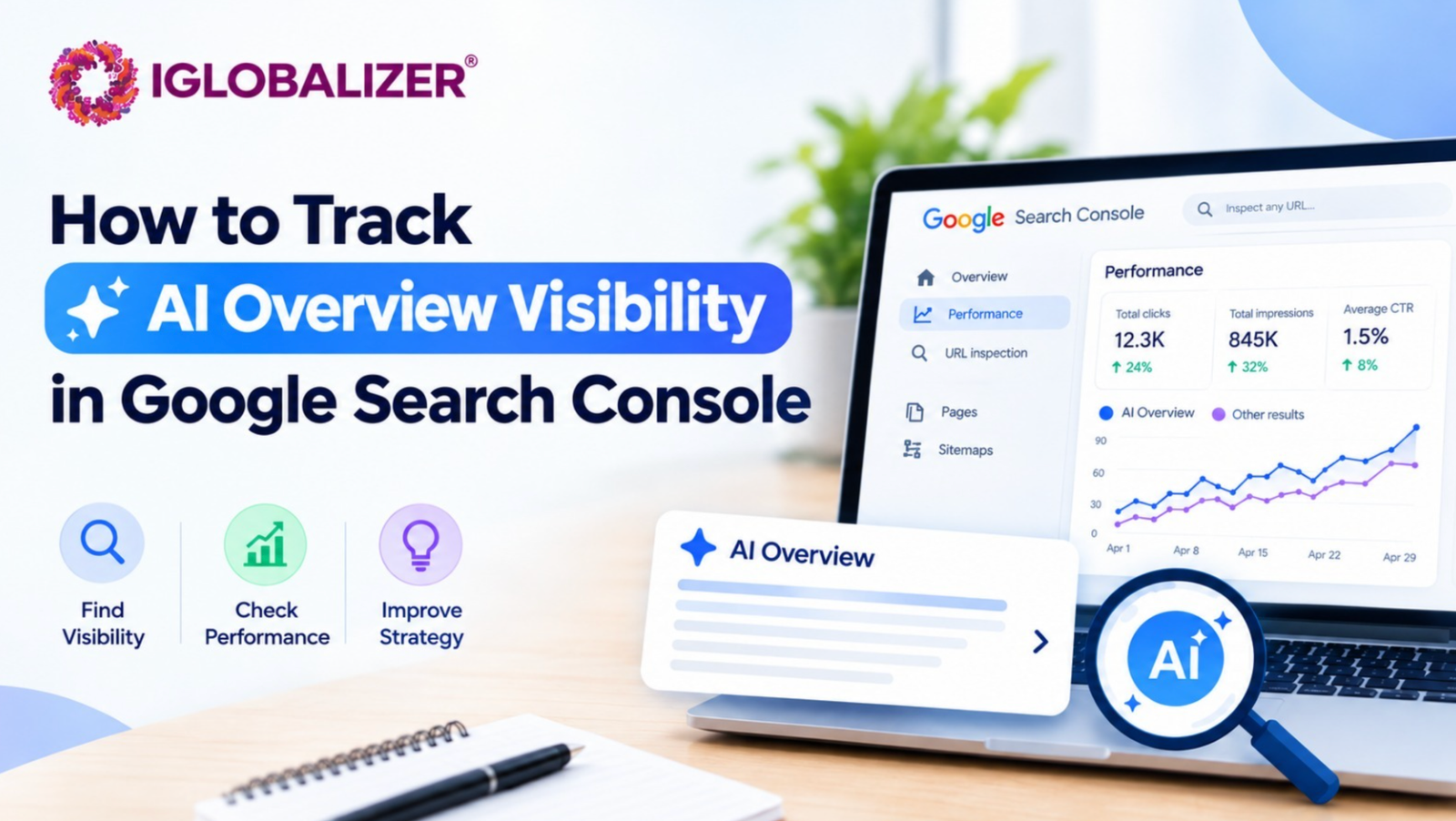
Google Search is changing fast. Users can now get answers to many queries through AI Overviews directly within search results.
This change has created a new question for businesses:
If your website appears in AI-driven search, how can you measure its visibility and performance?
Google Search Console is an important tool for this analysis. Its data can help you understand clicks, impressions, CTR, and search position.
However, measuring AI search only through traditional rankings is not enough. You also need to understand how your website's visibility is changing and what impact it has on business results.
What Is AI Overview Visibility?
AI Overview visibility refers to how visible your website content is within Google's AI-generated search experience.
It is different from traditional search rankings.
A website can:
-
Rank in traditional search results.
-
Appear as a source in an AI Overview.
-
Receive direct clicks from search results.
-
Gain visibility without every impression turning into a website visit.
Therefore, looking only at ranking position is not enough to understand AI search performance.
Why Should Businesses Track AI Overview Visibility?
AI-driven search is changing user behaviour.
For many queries, users can now get more information directly on the search results page.
Businesses should therefore understand:
-
Which topics are gaining visibility?
-
Which queries are generating impressions?
-
Which pages are bringing more traffic?
-
How is CTR changing?
-
Which pages need better optimisation?
-
How many organic visitors are becoming leads?
This data can help businesses build a stronger SEO and content strategy.
How to Track AI Overview Performance in Google Search Console
Start with the Performance report in Google Search Console to understand your search visibility.
Step 1: Open Google Search Console
-
Sign in to your Google Search Console account.
-
Select the correct website property.
-
Go to the Performance section.
-
Open the Search results report.
Here, you can find important data about your website's organic search performance.
Step 2: Check Important Search Metrics
Focus on these key metrics in the Performance report:
-
Total Clicks
-
Total Impressions
-
Average CTR
-
Average Position
Looking at these metrics together gives you a better view of search performance.
Do not make an SEO decision based on only one metric.
Step 3: Choose the Right Date Range
You need enough data to understand changes in AI search performance.
You can compare different periods, such as:
-
Last 28 days
-
Last 3 months
-
Last 6 months
-
Last 12 months
Longer date ranges can help you identify major changes in search behaviour.
Which Metrics Should You Track for AI Search Performance?
1. Impressions
Impressions show how often your website appeared in Google Search.
An increase in impressions can indicate growing search visibility.
However, more impressions do not automatically mean business growth.
2. Clicks
Clicks show how many users visited your website from Google Search.
Review this metric along with impressions.
For example:
-
20,000 impressions
-
800 clicks
This data helps you understand how much of your search visibility is turning into website traffic.
3. Click-Through Rate (CTR)
CTR shows how often users clicked your search result after seeing it.
For example:
-
Impressions are increasing.
-
CTR is decreasing.
In this case, you should examine how user behaviour is changing in search results.
AI-generated search experiences can provide users with more information directly on the search page.
Therefore, CTR changes should always be analysed in context.
4. Average Position
Average Position helps you understand your traditional search rankings.
However, you should not rely on this metric alone when analysing AI search.
Review rankings together with:
-
Impressions
-
Clicks
-
CTR
-
Landing pages
-
Search queries
This gives you a more complete view of search performance.
5. Organic Conversions
The main goal of SEO is not simply to increase traffic.
For a business, the more important question is:
Is that traffic turning into leads and customers?
Track actions such as:
-
Contact form submissions
-
Service enquiries
-
Phone calls
-
Demo requests
-
Quote requests
-
Purchases
-
Consultation requests
This data helps you understand the real business value of your search visibility.
How to Analyse AI Overview Visibility Through Search Queries
Not every keyword has the same business value.
It is better to group your queries based on search intent.
Informational Queries
These queries are used to find information.
Examples:
-
What is SEO?
-
What is AEO?
-
What is GEO?
-
How does technical SEO work?
-
What is AI Search?
Commercial Queries
These queries often indicate that a user is looking for a service or solution.
Examples:
-
SEO Company
-
SEO Services
-
AEO Services
-
Digital Marketing Agency
-
GEO Services
Problem-Based Queries
These queries show that a user is looking for a solution to a specific problem.
Examples:
-
How to increase website traffic?
-
Why is my Google ranking dropping?
-
How to improve organic traffic?
-
How to optimise a website for AI Search?
Classifying queries this way helps you understand which search intents are bringing visibility to your website.
Analyse Landing Pages, Not Just Keywords
Looking at search queries alone is not enough.
You should also identify which pages are gaining search visibility and traffic.
Pay special attention to pages with:
-
High impressions
-
Good clicks
-
Low CTR
-
Traffic from multiple queries
-
Visibility for important commercial keywords
-
High traffic but low conversions
These pages can become your next optimisation opportunities.
What Does High Impressions but Low Clicks Mean?
Suppose a page receives:
-
50,000 impressions
-
1,000 clicks
It would be too early to say that the page is performing poorly.
You need to analyse:
-
Which queries are showing the page?
-
What is the search intent?
-
Where does the page rank in traditional results?
-
How much information is already available to users in the search results?
-
How relevant are the page title and description?
-
Does the landing page address the user's needs?
This analysis helps you identify the right area for improvement instead of simply identifying a problem.
How to Improve AI Search Visibility
Once you have search data, the next step is optimisation.
1. Understand Search Intent
Every page should provide a clear answer to the user's search intent.
Your content should:
-
Provide direct answers.
-
Present important information early.
-
Remove unnecessary information.
-
Cover related questions naturally.
2. Improve Content Structure
Make your content easy to understand for both AI-driven and traditional search.
Use:
-
Clear headings
-
Short sections
-
Bullet points for important information
-
Relevant examples
-
Logical connections between related topics
3. Strengthen Topical Coverage
Creating one article about a topic is not always enough.
Build a stronger content ecosystem by covering relevant subtopics.
For example, an AI Search content strategy can cover:
-
AI Overviews
-
AEO
-
GEO
-
AI Search Optimisation
Useful content across related topics can help build stronger topical coverage.
4. Improve Internal Linking
Connect relevant pages across your website.
This can:
-
Help users find additional information.
-
Help search engines understand your website structure.
-
Support important pages through better internal linking.
5. Do Not Ignore Technical SEO
Content is important for AI search, but a strong technical foundation also matters.
Review areas such as:
-
Crawling
-
Indexing
-
Page speed
-
Mobile experience
-
Site architecture
-
Internal links
-
Structured data where relevant
Combine AI Search with Traditional SEO
The rise of AI Overviews does not mean traditional SEO is over.
A strong search strategy should include both.
Traditional SEO
-
Technical SEO
-
Keyword research
-
On-page optimisation
-
Internal linking
-
Content quality
-
Authority building
AI Search Optimisation
-
Clear answers
-
Strong topical coverage
-
Question-based content
-
Structured information
-
Helpful and trustworthy content
-
AEO and GEO strategies
The right approach is:
SEO Foundation + AI Search Optimisation + Conversion Strategy
How to Connect Search Console Data With Business Growth
Do not use search data only for monthly reports.
Use it to support real business decisions.
Follow this process:
1. Discover
Identify high-value queries and important pages.
2. Measure
Analyse clicks, impressions, CTR, and position.
3. Compare
Compare current performance with the previous period.
4. Optimise
Work on weak pages and content gaps.
5. Convert
Measure how many organic visitors become qualified leads and customers.
This approach can turn SEO from a simple ranking activity into a business growth channel.
Common Mistakes When Tracking AI Search
Businesses often make mistakes when measuring AI search performance.
Avoid these:
-
Focusing only on keyword rankings.
-
Treating impressions alone as a sign of success.
-
Interpreting CTR changes without context.
-
Ignoring informational queries.
-
Not tracking conversions from high-traffic pages.
-
Changing SEO strategy based on very limited data.
-
Focusing only on AI optimisation and ignoring traditional SEO.
-
Adding keywords instead of improving content quality.
A better strategy looks at visibility, traffic, and conversions together.
Improve Your AI Search Visibility With iGlobalizer
In the age of AI-driven search, ranking on Google alone is no longer enough.
Businesses need to understand how their content:
-
Performs across search engines.
-
Reaches the right users.
-
Gains visibility in AI-driven search.
-
Generates meaningful business results.
iGlobalizer helps businesses develop modern search strategies across SEO, AEO, and GEO.
Our focus is not limited to increasing visibility.
We work to connect search performance with real business objectives.
Our search strategy can include:
-
SEO Strategy
-
Technical SEO
-
Keyword Research
-
Content Optimisation
-
On-Page SEO
-
AEO
-
GEO
-
Internal Linking
-
Search Intent Analysis
-
Organic Traffic Analysis
-
Conversion-Focused Optimisation
If you want your website to build stronger visibility in both traditional Google Search and AI-driven search, start with the right data and strategy.