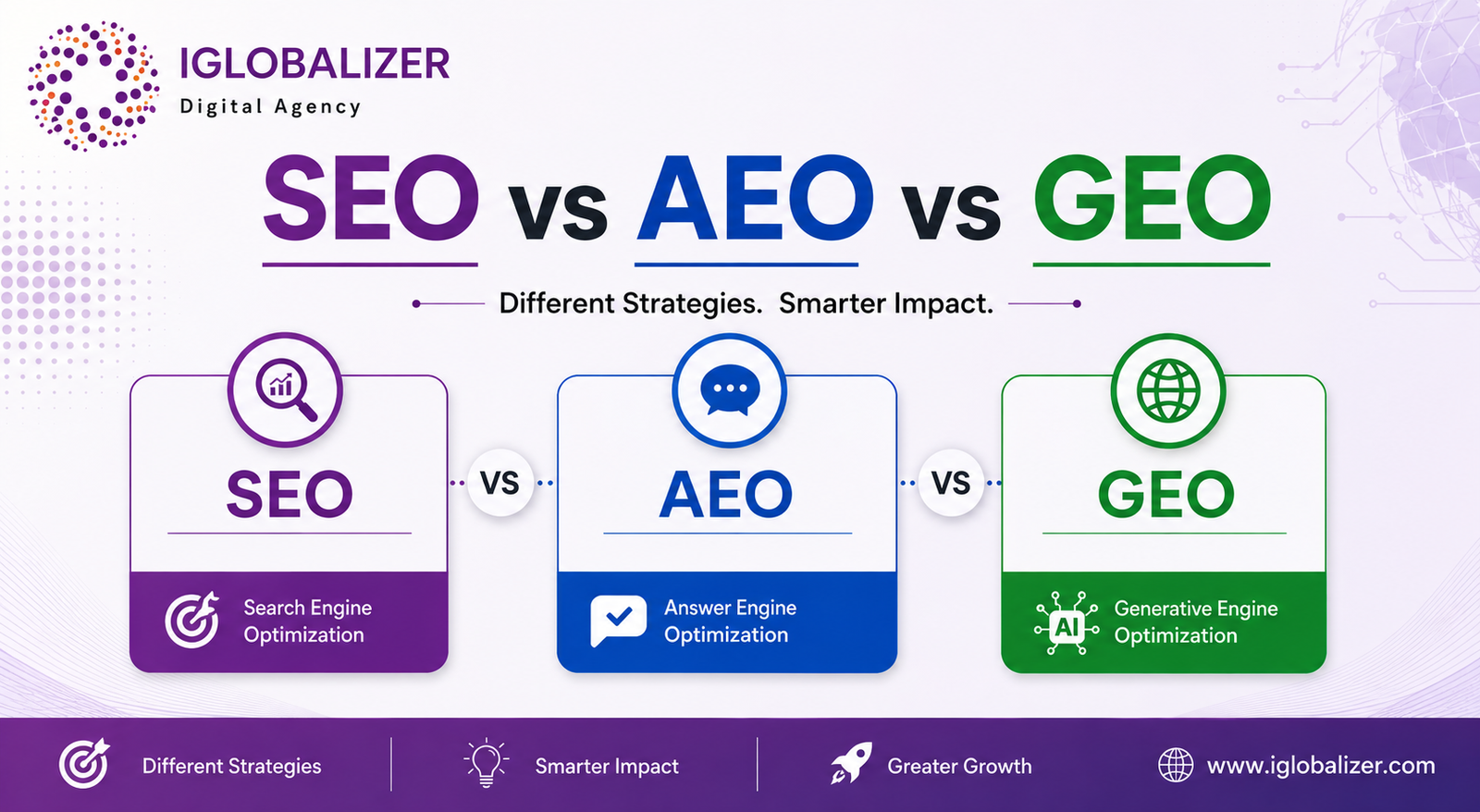
AEO vs SEO vs GEO: Which Strategy Does Your Business Need?
People still use Google to find websites, products, and services. However, they now also ask AI tools to explain a topic, compare options, or suggest a solution.
This has brought three terms into focus: SEO, AEO, and GEO.
They are related, but they are not exactly the same. More importantly, businesses should understand where each one fits instead of treating them as three separate trends.
SEO Helps Your Website Get Found in Search
SEO stands for Search Engine Optimization. It is about making a website better so that search engines can find it figure out what it is, about and put it higher in the results.
For instance a website that sells furniture might want to show up when someone looks for dining tables. A hotel might want to be seen when people search for rooms or places to stay. A company that makes software might want to be when people look for a certain kind of software.
SEO usually covers:
- Keyword research – Finding what people search for.
- Content optimization – Creating useful pages around those searches.
- Technical SEO – Improving crawling, indexing, speed, and website structure.
- Internal linking – Connecting related pages in a useful way.
- Authority building – Earning relevant links and building trust around the website.
SEO remains the foundation of modern search. Google also confirms that its core SEO practices continue to apply to AI features such as AI Overviews and AI Mode.
Without a strong SEO foundation, other search strategies may have limited value.
AEO Focuses on Giving Clear Answers
AEO means Answer Engine Optimization. The term is generally used for work aimed at making content easier for answer-focused search experiences to understand and use.
Think about how people search today.
Instead of typing:
“best laptop for graphic design”
a person may ask:
“What should I look for in a laptop for graphic design?”
The second search needs a useful answer, not just a list of pages.
AEO therefore puts more focus on questions, direct answers, and clear explanations.
Businesses can support this by creating content that:
- Answers common customer questions.
- Gives the main answer early.
- Uses clear headings and simple language.
- Explains complex topics in small sections.
- Adds useful details instead of repeating general information.
This can be useful for almost any business. A bank can answer questions about account types. A travel company can explain visa or booking requirements. An electronics brand can answer product-related questions.
The goal is simple: make the useful answer easy to understand.
GEO Brings Generative AI Into the Picture
GEO stands for Generative Engine Optimization. The term is used for efforts focused on visibility in generative AI search experiences.
A user may ask an AI tool:
“Which digital marketing agencies can help a B2B company improve SEO and AI search visibility?”
For a business to be considered in such a conversation, it needs more than keyword-focused pages. Its website should clearly explain its expertise, services, experience, and value.
GEO can involve areas such as:
- Creating useful and original content.
- Demonstrating real expertise and experience.
- Building a consistent brand presence across relevant sources.
- Creating detailed content around important topics.
- Making business information easy to understand and verify.
Google's current guidance also stresses valuable, original, people-first content rather than special “AI hacks.”
SEO vs AEO vs GEO: What Is the Difference?
The easiest way to understand the three is to look at the search experience they address.
|
Strategy |
Main Focus |
Simple Example |
|
SEO |
Ranking in search results |
A product page appears on Google |
|
AEO |
Providing direct answers |
A page clearly answers a customer question |
|
GEO |
Visibility in generative AI responses |
An AI tool mentions or cites a useful source |
There is also some overlap between AEO and GEO. Different agencies and practitioners use these terms in slightly different ways. Some use AEO as a broad term for answer-focused optimization, while others use GEO specifically for generative AI systems.
So, businesses should focus less on the labels and more on the actual search behaviour they want to support.
Which Strategy Should Your Business Use First?
The right approach depends on where your business stands today.
Choose SEO First If Your Website Needs a Strong Foundation
If your website has technical issues, weak content, poor rankings, or limited organic traffic, start with SEO.
Fix the basics before moving to advanced search strategies.
Focus on:
- Technical SEO
- Keyword research
- Website structure
- Helpful content
- Internal linking
- Page experience
A strong foundation makes future AEO and GEO efforts more effective.
Add AEO When Your Customers Have Many Questions
AEO is really helpful when customers want to know something before they decide to buy something.
This happens a lot, with businesses that sell things.
For instance a financial service provider has to tell people about the fees they charge who's eligible what the risks are and how to apply. A software company has to explain what their product can do how it works with products how much it costs and what people can use it for.
When you have content that gives people the answers they need it helps them go from looking around to really thinking about buying something from the AEO, which is the answer-focused content that helps users move from simple research to serious consideration of the AEO.
Consider GEO as AI Becomes Part of Your Customer Journey
If your customers are using intelligence tools to look up products or services or companies or topics, in an industry GEO can be a part of your larger plan to find information.
The main goal is to create a brand that artificial intelligence systems can recognize and people can believe in.
This means your website needs to show your knowledge the services you offer the experience you have and the value you provide.
Why Businesses Should Combine SEO, AEO, and GEO
Choosing only one strategy may create gaps in your search visibility.
A better approach is to build them together.
SEO provides the technical and content foundation. AEO helps your business answer important questions clearly. GEO extends the strategy toward generative AI experiences and broader brand visibility.
For example, a B2B software company could use SEO to improve its product and service pages. It could then create AEO-focused content answering buyer questions and develop deeper expert content that supports GEO efforts.
This creates a connected search strategy instead of three separate campaigns.
Focus on Useful Content Instead of Search Tricks
The rise of AI search has created many new optimization ideas. However, businesses should be careful with tactics that promise instant AI visibility.
There is no need to create hundreds of similar pages. There is also no reason to fill content with keywords just to appear more relevant.
Instead, ask three simple questions:
- Does this content answer a real question?
- Does it provide something useful or original?
- Can the reader understand it without extra effort?
If the answer is yes, you are building a stronger search asset.
Google's current guidance also stresses useful, original, people-first content rather than special techniques designed only to influence AI systems.
Build a Search Strategy That Matches Your Business Goals
SEO, AEO, and GEO should not be treated as trends that every business must follow in the same way.
The right mix depends on your audience, industry, competition, website quality, and buying journey.
Start with the foundation. Understand what your customers search for. Create useful answers. Demonstrate genuine expertise. Then expand your strategy as your search landscape changes.
Google's current guidance makes one point clear: strong SEO fundamentals, useful content, technical accessibility, and a good user experience remain important even as search becomes more generative.
Ready to Build a Smarter Search Strategy?
Search is changing from how it used to be. Companies now have to think about how people find information using both search engines and artificial intelligence experiences.
IGlobalizer helps companies increase how visible they are online, through SEO, AEO, GEO, content strategy, e-commerce SEO and other results-driven options.
Want to find out which method works best for your company? Talk to iGlobalizer. Create a search plan that focuses on better visibility more relevant visitors and ongoing success.