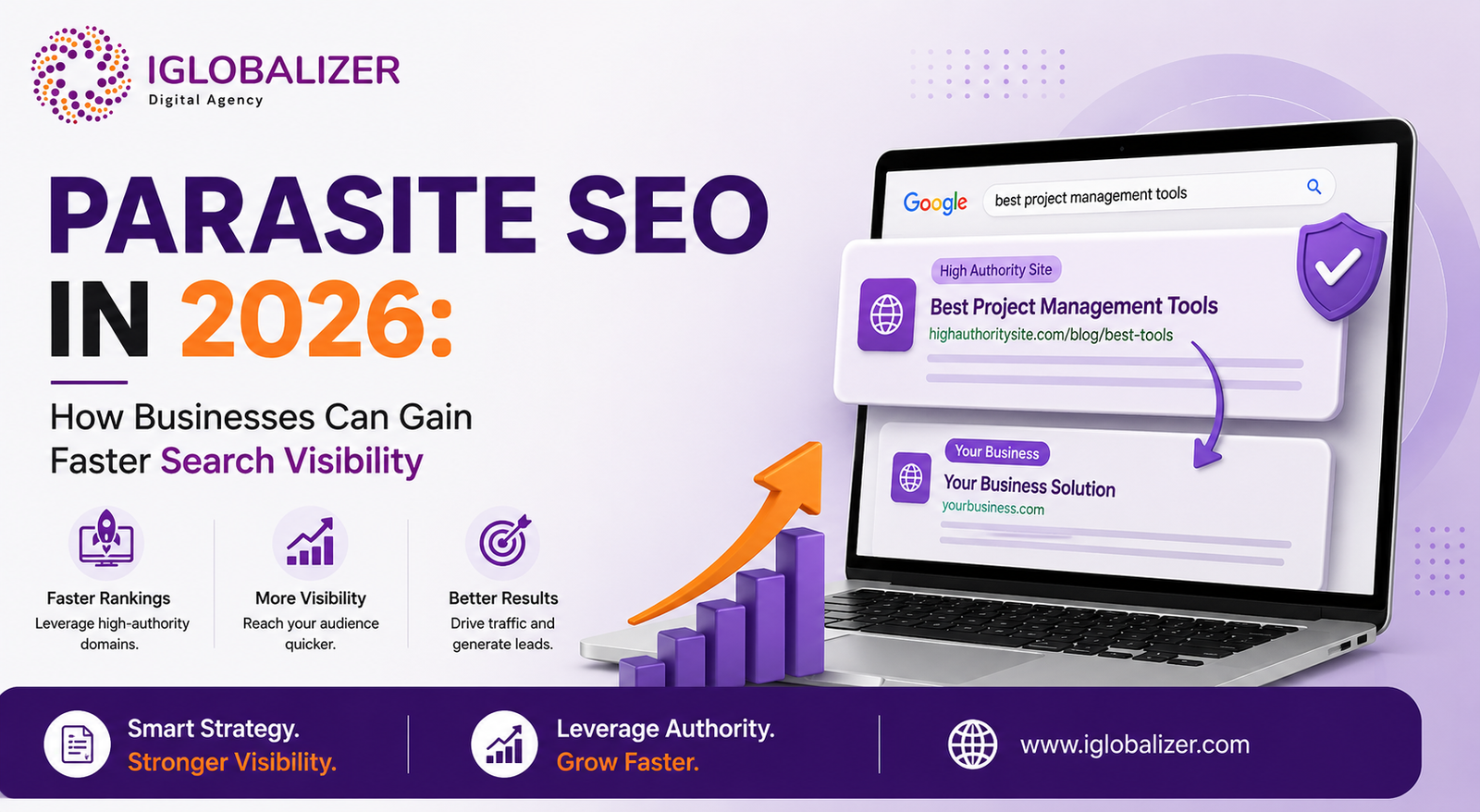
Parasite SEO in 2026: How Businesses Can Gain Faster Search Visibility
Ranking a new website for competitive keywords can take time. New domains need strong content, quality links, and trust before they can compete with older websites.
Parasite SEO offers another way to gain search visibility. It uses established websites to publish content around specific search terms. These sites may already have strong visibility, regular traffic, and many indexed pages.
However Parasite SEO is not a way to get higher rankings. Results depend on the platform, the quality of the content what people are looking for how competition there is and the overall SEO plan.
This guide explains how Parasite SEO works, where it can be useful what dangers to stay from and how companies can use it as part of a bigger SEO plan in 2026.
What Is Parasite SEO?
Parasite SEO is a method where I put content on a third‑party website to focus on a search term and to get seen in search results.
The host website is normally a well‑known domain that already has authority, traffic and a presence in search. Of waiting for a new domain to earn the same trust marketers use a relevant platform to publish useful content.
For example I see a new business might want to hit a keyword. Its own site may still lack authority to compete with older domains. An article posted on an established website can have a chance of appearing in search results.
The aim is not to drop a link. The page that is posted should answer the question that people search for give information and add value for readers.
Parasite SEO becomes more, than a link‑building trick. It is a content strategy that boosts search visibility and can help run SEO campaigns.
How Does Parasite SEO Work?
A successful Parasite SEO campaign starts with research. The main steps include keyword selection, platform research, content creation, page optimization, and performance tracking.
I. Define the SEO Goal
Start with a clear goal. It may be:
- Search visibility
- Brand awareness
- Referral traffic
- Leads
- Product exposure
- Testing a competitive keyword
The goal helps shape the keyword, content, and platform selection.
II. Research Target Keywords
Choose keywords that match your business and audience.
Do not focus on search volume. Search intent is also important. A keyword, with volume can still be useful if it brings in users who are ready to take action.
Long-tail keywords can also be helpful. They usually have specific intent and might have less competition.
III. Choose a Relevant Authority Website
The host website should have a real audience and a clear connection to your topic.
Look at:
- Organic traffic
- Topic relevance
- Search visibility
- Content quality
- Audience
- Publishing rules
- Link policies
Do not choose a platform only because it has a high authority score.
IV. Create Content That Helps People
The content needs to answer the question that the reader has.
Use a title, helpful headings, short paragraphs, examples and sources that are relevant. Make sure the keywords are included in a way.
V. Improve the Page and Check Its Performance
Do on-page SEO, for the page once it is published.
After it is live check how well it is doing. Look at rankings how times it appears how many people click on it, where the traffic is coming from how people interact with it and if it leads to the desired actions.
This shows if the effort is working and if it is giving outcomes.
Parasite SEO vs Traditional SEO
Parasite SEO and traditional SEO have different roles.
Traditional SEO focuses on your own website. It improves technical health, content, internal links, backlinks, user experience, and overall site strength.
Parasite SEO focuses on a page published on another website.
|
Parasite SEO |
Traditional SEO |
|
Uses a third-party website |
Uses your own website |
|
Targets selected pages |
Builds the full website |
|
Uses an established platform |
Builds your own authority |
|
Platform control is limited |
You control the website |
|
Useful for targeted campaigns |
Builds long-term SEO value |
The two methods do not have to compete. Parasite SEO can support a specific campaign while traditional SEO continues to build the long-term strength of your own website.
Parasite SEO vs Guest Posting
Parasite SEO and guest posting can look similar because both involve publishing content on another website.
The main difference is the goal.
Guest posting often focuses on brand exposure, referral traffic, relationships, and relevant backlinks.
Parasite SEO focuses more on getting the published page to rank for a target search term.
The two can also work together. A useful guest article may rank in search, while a Parasite SEO page may also bring referral traffic and brand exposure.
For businesses that already use content marketing and link building, Parasite SEO can become another part of the wider off-page strategy.
Benefits of Parasite SEO for Businesses
When planned well, Parasite SEO can offer several benefits.
I. Access to Established Websites
A new website may need time to build strong search signals. An established platform may already have good visibility and a history of ranking content.
Publishing on a suitable website can give a campaign access to that existing search environment.
II. Targeted Search Visibility
Businesses can build pages that focus on chosen keywords and the intent behind searches.
This can help businesses test topics or reach people looking for a particular service, product or solution.
III. Brand Exposure
A helpful article on a website can introduce your business to a fresh audience.
This can help companies when they enter a market or launch a new service.
IV. Referral Traffic
A strong page can attract visitors from both search engines and the host website.
When the platform hosts the audience this traffic can bring real business value.
V. Support for Off-Page SEO
Parasite SEO can complement guest posting, content marketing, PR and link‑building activities.
Parasite SEO should be seen as one part of a SEO plan, not a replacement, for traditional SEO.
Risks and Limitations of Parasite SEO
Parasite SEO can be useful, but it also has limits.
I. Limited Control
You do not own the third-party website. The publisher may change its rules, edit the page, remove the article, or change how links are handled.
II. Platform Policy Changes
Publishing rules can change over time. A platform that accepts certain content today may have different rules later.
III. Low-Quality Platforms
Some websites accept large amounts of paid or unrelated content. A high authority score does not always mean the platform is useful.
IV. Ranking Changes
Search rankings can move because of competition, search changes, content updates, or changes on the host website.
V. Reputation Risk
Your brand becomes associated with the platform where the content appears. An irrelevant or poor-quality website may create a weak brand impression.
VI. It Does Not Build Your Website Directly
A successful Parasite SEO page can perform well in rankings. The real power comes from the host page and its domain.
Your own website still requires content, proper technical SEO, backlinks and a great user experience.
How to Choose the Right Website for Parasite SEO
Platform selection is one of the most important parts of a Parasite SEO campaign.
I. Check Topic Relevance
The website should be related to your industry or audience.
For example, a technology company should look for a suitable technology or business platform instead of an unrelated website with a high authority score.
II. Check Real Organic Traffic
Look beyond Domain Authority and similar metrics.
Check whether the website ranks for useful keywords and receives real organic traffic.
III. Review Existing Content
Read several articles before choosing the platform.
Look for useful and original content. Avoid sites filled with thin promotional posts.
IV. Study the Audience
A website can have high traffic and still be a poor fit.
The audience should match the people you want to reach.
V. Check Link and Publishing Rules
Understand the site's content and link policies before publishing.
Some websites may restrict links or require sponsored tags.
How to Build a Parasite SEO Strategy in 2026
A clear process makes the campaign easier to manage.
I. Understand the Business Goal
Start with the business, audience, product, service, and target market.
The keyword should have a clear connection with the business goal.
II. Study the Competition
Review the pages ranking for your target keywords.
Look at their content, structure, search intent, and backlink profiles. This can reveal gaps and new opportunities.
III. Select the Right Keywords
Consider:
- Search intent
- Competition
- Business value
- Audience needs
- Market relevance
High search volume is not always the best choice.
IV. Find Suitable Platforms
Shortlist websites with relevant topics, real traffic, good content standards, and a suitable audience.
Compare quality instead of choosing the first high-authority website you find.
V. Create Original Content
Give readers useful information. Add examples, clear explanations, practical advice, and relevant sources where needed.
Avoid creating an article only to place a keyword or link.
VI. Optimize the Published Page
Use a clear title and heading structure. Place keywords naturally and keep paragraphs easy to read.
Make sure the page works well on desktop and mobile devices.
VII. Track and Improve
Monitor rankings, impressions, traffic, engagement, leads, and conversions.
If the page does not perform well, review the keyword, platform, content, and search intent.
On-Page SEO Tips for Parasite Content
A strong platform cannot fix weak content.
The published page should still follow basic SEO practices.
Use the main keyword naturally in the title, introduction, and relevant headings. Add related terms instead of repeating one phrase.
Keep paragraphs short and use clear H2 and H3 headings. Add images when they improve the reader's understanding.
Use relevant internal and external links where they add value.
Most importantly, write for the reader first. Content that answers the search query clearly is more useful than a page created only for search engines.
How to Measure Parasite SEO Results
Ranking position is only one part of the campaign.
I. Search Performance
Track:
- Keyword rankings
- Impressions
- Clicks
- Search visibility
II. Traffic
Check organic traffic and referral traffic from the host website.
III. Engagement
See how visitors interact with the page and whether the content meets their needs.
IV. Leads and Conversions
For commercial campaigns, track enquiries, sign-ups, sales, or other useful actions.
The final goal should not be a ranking number alone. It should be meaningful business growth.
Is Parasite SEO Still Effective in 2026?
Parasite SEO can still be useful in 2026, but the old idea of using any high-authority website for quick rankings is outdated.
Search has become more focused on useful content, relevance, trust, and user needs. A page can still fail if it does not answer the search query well.
Low-quality content published on unrelated websites is also not a sustainable SEO strategy.
A modern Parasite SEO campaign should focus on three things:
Relevance. Quality. User value.
The platform should fit the topic. The content should match search intent. Links should be relevant, and the campaign should have a clear business goal.
Parasite SEO Best Practices
Keep these points in mind:
- Choose relevant websites.
- Study the audience before publishing.
- Match content with search intent.
- Create original content.
- Use keywords naturally.
- Avoid keyword stuffing.
- Look beyond domain metrics.
- Follow publisher rules.
- Avoid low-quality publishing networks.
- Use relevant links.
- Track rankings and traffic.
- Measure business results.
- Continue improving your own website.
When Should a Business Consider Parasite SEO?
Parasite SEO may be useful when a business wants to:
- Test a competitive keyword
- Reach a new audience
- Improve brand exposure
- Promote a product or service
- Enter a new market
- Support an off-page SEO campaign
It may be less useful when there is no clear goal or when the campaign depends only on links.
Businesses should also avoid treating Parasite SEO as a replacement for their main website.
Your own website remains the long-term asset. Technical SEO, useful content, internal linking, backlinks, and user experience should continue to receive attention.
Parasite SEO and Long-Term SEO
The strongest SEO plans do not depend on one tactic.
A wider strategy may include:
- Technical SEO
- On-page SEO
- Keyword research
- Content marketing
- Link building
- Guest posting
- Local SEO
- International SEO
- Ecommerce SEO
- Conversion optimization
Parasite SEO can help this mix when there is a reason to use it.
For example a business can grow its site over time while also using chosen third‑party sites to reach new audiences or hit specific search terms.
This gives a balance between quick chances and long‑term SEO growth.
How iGlobalizer Approaches Parasite SEO
Parasite SEO works best when it is treated as part of a complete SEO plan, not just a publishing task.
iGlobalizer can bring Parasite SEO into a wider SEO strategy that covers areas such as keyword research, on-page work, off-page activities, technical SEO, link building, guest posting, international SEO, and ecommerce SEO.
I. Understanding the Business Goal
The first step is to understand what the business wants to achieve.
A campaign for brand awareness may need an approach than a campaign that focuses on leads or, on competitive commercial keywords.
The target market also matters. A strategy for a local business may be very different from one built for an international brand.
II. Researching Keywords and Search Intent
Keyword selection should go beyond search volume.
The focus should be on terms that fit the audience, market, competition, and business goal.
Search intent is equally important. The published content should give users the type of answer they expect from the search.
III. Finding Relevant Platforms
The publishing platform can have a major effect on the campaign.
iGlobalizer can use its wider off-page and guest-posting knowledge to assess whether a platform fits the topic, audience, and campaign goal.
This helps avoid the common mistake of choosing a website only because it has a strong authority score.
IV. Creating Search-Focused Content
A Parasite SEO page should be useful on its own.
Your writing should answer the search query. You need to use a structure. Importantly you must provide information that readers can trust.
The goal is not to create a page that exists for a link. You should create a piece of content. A useful piece of content will. Engage the right audience.
V. Connecting Parasite SEO With Off-Page SEO
Parasite SEO can support a wider off-page strategy.
Link building, guest posting, content marketing and digital outreach can work together when link building, guest posting, content marketing and digital outreach follow one goal. This broader approach can help businesses avoid depending on a SEO tactic.
VI. Monitoring Campaign Performance
A campaign should not end after publication.
You should look at your rankings, impressions, traffic, engagement and business results, over a period of time.
The data can show you which keywords and platforms are working well and which parts of the strategy need work.
Why iGlobalizer Is a Better Choice
Choosing the right SEO partner matters because Parasite SEO requires more than publishing an article on an authority website.
I. Wider SEO Expertise
iGlobalizer works across several areas of SEO, including technical SEO, on-page SEO, off-page SEO, keyword research, link building, guest posting, international SEO, and ecommerce SEO.
This makes it easier to connect a Parasite SEO campaign with other parts of a wider SEO plan.
II. Business-Focused Strategy
Different businesses have different goals.
A startup may need brand visibility. An ecommerce company may want product traffic. A B2B business may focus on qualified leads.
The strategy should reflect these differences instead of using the same approach for every business.
III. Research-Based Planning
Good SEO starts with research.
Competitors, search terms, audience needs, content gaps, and market conditions can all influence the campaign.
iGlobalizer can use these factors to build a Parasite SEO strategy that is more focused on the actual business goal.
IV. Content and SEO Work Together
A published page needs more than a target keyword.
It needs useful information, the right search intent, a clear structure, and natural optimization.
iGlobalizer also works across SEO content and broader digital marketing, allowing content and SEO activities to support each other.
V. Support for Different Business Needs
Parasite SEO can be used in different markets when the right platform and content strategy are selected.
iGlobalizer works with different types of businesses and offers SEO solutions for areas such as ecommerce, local search, international markets, and broader organic growth.
Ready to Build a Smarter Parasite SEO Strategy?
Parasite SEO can create new opportunities for search visibility, but success depends on the strategy behind it.
The right keyword, relevant platform, useful content, smart optimization, and regular tracking all matter.
If you want to use Parasite SEO for your business, iGlobalizer can help you build a strategy around your keywords, audience, market, and SEO goals.
Instead of treating Parasite SEO as a quick ranking trick, make it part of a wider search strategy.
Talk to iGlobalizer today and explore a Parasite SEO strategy built around your business goals.